
How to get your business recommended by ChatGPT and other AI tools
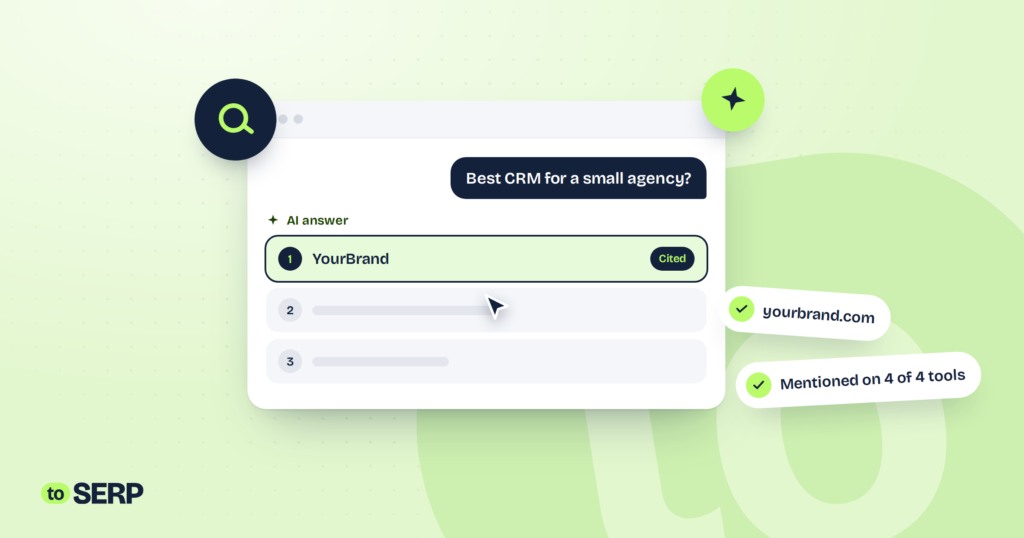
Ask ChatGPT “who’s the best accountant for a small online store?” or “what’s the best CRM for a five-person agency?” and you’ll get an answer that names a handful of businesses. Not ten blue links. A shortlist. For a growing number of buyers, that shortlist is where the search starts and ends.
So the question every business owner is now asking is simple: how do I get on it? This guide explains how AI tools decide what to recommend, and the practical steps that improve your chances. No gimmicks, no “secret prompts”. Just the work that actually moves the needle.
Key takeaways
- AI tools recommend businesses that are easy to understand, consistently described and widely mentioned by sources they trust.
- Most AI tools that browse the web build on search results, so solid SEO is still the foundation.
- Answer-first pages, consistent brand facts and third-party mentions are the three biggest levers.
- Measure progress by tracking the same buyer questions every month, not by checking a single answer.
Why AI recommendations matter now
Buyers didn’t stop searching. They added a new step. Many now ask an AI tool to explain their options, compare providers and suggest who to call, before they ever visit a website. The numbers show how fast this has moved:
That last number matters most. When an AI summary answers the question, fewer people click through to websites at all. If your business isn’t named in the answer itself, you can rank well and still be invisible to the buyer who never scrolls past it.
How AI tools decide who to recommend
There’s no single algorithm to reverse-engineer, but every major AI tool draws on some mix of the same three things.
1. What the web already says about you
Language models learn from huge amounts of public text. If your business is described clearly and often, on your own site and on others, the model is more likely to “know” what you do and who you serve. If you’re rarely mentioned, or described five different ways, it has little to go on.
2. What it finds when it searches
ChatGPT search, Perplexity, Gemini and Google’s AI Overviews all look things up in real time for many questions. They pull from pages that search engines can crawl, understand and trust. That’s why a page that ranks well and answers a question directly is far more likely to be quoted than a page that doesn’t.
3. Agreement across sources
AI tools try to give a safe, well-supported answer. When several independent sources, such as review sites, industry lists and articles, all say similar things about you, you become an easy recommendation. When they disagree or say nothing, you’re a risk the model avoids.
7 steps to get your business recommended
Step 1: List the questions your buyers actually ask
Start with 20 to 50 real questions a buyer might type, such as “best [service] for [type of business]”, “[your service] cost”, “[competitor] alternatives”, and problem questions like “why is my website getting traffic but no leads”. Your sales calls, support emails and Google Search Console queries are the best sources.
Step 2: Check where you stand today
Ask each question in ChatGPT, Perplexity, Gemini and Google, and record three things: whether you’re mentioned, whether you’re linked or cited as a source, and who gets recommended instead. This baseline tells you where the gaps are and gives you something to measure against.
Step 3: Make your site easy for AI tools to read
Check that your robots.txt doesn’t block the crawlers AI tools use, such as OAI-SearchBot and GPTBot for OpenAI and PerplexityBot for Perplexity. Make sure your key content loads as text in the page rather than only appearing after scripts run, and use clear headings that say what each section covers.
Step 4: Write answer-first pages
AI tools quote content that answers a question directly. Put the answer in the first two sentences, then add the detail. The pages that matter most are your service pages, pricing, comparison pages (“[you] vs [competitor]”) and a genuinely useful FAQ. Specifics win: numbers, timelines, who it’s for and who it isn’t for.
Want to know which questions you’re already showing up for? Our Growth Audit benchmarks your AI visibility
Step 5: Make your brand facts consistent everywhere
Your business name, one-line description, services and location should match across your website, Google Business Profile, LinkedIn, directories and review sites. Add Organization structured data to your site so search engines can connect the dots. Inconsistency is one of the most common reasons AI tools describe a business wrongly.
Step 6: Earn mentions on sources AI tools trust
This is the slowest step and the most powerful. Ask happy clients for reviews on the platforms your industry uses. Get included in reputable “best of” lists and directories. Contribute expert quotes and articles to industry publications. Every credible, independent mention makes you a safer recommendation.
Step 7: Track the trend every month
Run the same questions monthly and track the share where you’re mentioned or cited, plus whether the description is accurate. AI answers change from day to day, so a single check proves little. A trend across dozens of questions tells you whether the work is paying off.
What helps, and what to avoid
Some tactics sold as “AI SEO” don’t help, and a few can backfire. Here’s how the common ones compare.
| Tactic | Worth it? | Why |
|---|---|---|
| Answer-first service and comparison pages | Yes | Gives AI tools a clear, quotable answer to the questions buyers ask |
| Consistent name and description everywhere | Yes | Helps AI tools identify you correctly and describe you accurately |
| Reviews and third-party mentions | Yes | Independent agreement makes you a safer recommendation |
| Allowing AI crawlers in robots.txt | Yes | Tools can’t cite pages they’re blocked from reading |
| Stuffing pages with keywords or AI buzzwords | No | Makes pages harder to read and quote, for people and AI alike |
| Hidden text or instructions aimed at AI | No | Treated as manipulation and can damage trust in your site |
| Fake reviews or paid link schemes | No | Breaks platform rules and can get you removed or penalized |
How long does it take?
Technical fixes, like unblocking crawlers and cleaning up brand facts, can take effect within weeks, as AI tools re-crawl your site. Answer-first content usually starts showing up in citations within one to three months. Earning a reputation across third-party sources takes longer, typically several months of steady work.
The businesses that win here aren’t the ones chasing a trick. They’re the ones that become the clearest, most consistently described and most widely recommended option in their space. That happens to be exactly what good marketing has always aimed for.
Frequently asked questions
Can I pay to get recommended by ChatGPT?
No. Organic recommendations in ChatGPT, Perplexity, Gemini and Google’s AI Overviews can’t be bought. They’re shaped by what the web says about you: your own pages, reviews, articles and lists that mention you. That’s why the work looks a lot like good SEO and good PR combined.
Which AI tools should a business focus on?
Start with the ones your buyers use most. For most businesses that means ChatGPT and Google’s AI Overviews, followed by Perplexity and Gemini. The good news is that the same groundwork helps you across all of them.
Does SEO still matter if buyers use AI tools?
Yes. AI tools that search the web lean heavily on pages that already rank well and are widely referenced. Strong SEO is the foundation; AI search optimization builds on top of it.
How do I know if it’s working?
Track the same list of buyer questions every month and record whether you’re mentioned or cited, and whether the description is accurate. AI answers vary from one day to the next, so look at the trend across many questions, not a single answer.